FlowForge Manual
CHAPTER 08 ENTime, Billing & Proof of Work
Turning tracked sessions into client-ready reports, team billing, and the proof that you were paid fairly.
Time, Billing & Proof of Work
This is where the receipt pays off. FlowForge’s soul is the craft and the Never Alone partnership (Chapter 1); getting paid is the feature that keeps that partnership honest to both sides. The mechanism is simple: the tracked work of every prior chapter becomes proof, and proof becomes a defensible record — an invoice you can stand behind, a raise you can justify, a “trust me” you never have to say. This chapter covers how tracked sessions turn into reports, how team billing aggregates, and why the receipt is such a strong feature.
Every session is a billable record
Because session-start began a timer the moment you and ACE started work — tied to a ticket — every hour you worked is already:
- attributed to a ticket (the what),
- timed (the how long), and
- attached to a branch and a summary (the proof).
Nothing extra is required of you at billing time. The record was created as a side effect of working the disciplined way. That’s the design: make the honest path the automatic path, and the invoice writes itself.
From sessions to client-ready reports
FlowForge’s customers use it to bill their clients, so reporting is first-class:
- Per-ticket and per-session breakdowns — what was done, and for how long.
- Team rollups — hours by developer, by ticket, by milestone.
- Branded, client-ready exports — reports that carry a project’s own logo and a mandatory “powered by FlowForge” mark, professional enough to hand straight to a paying client.
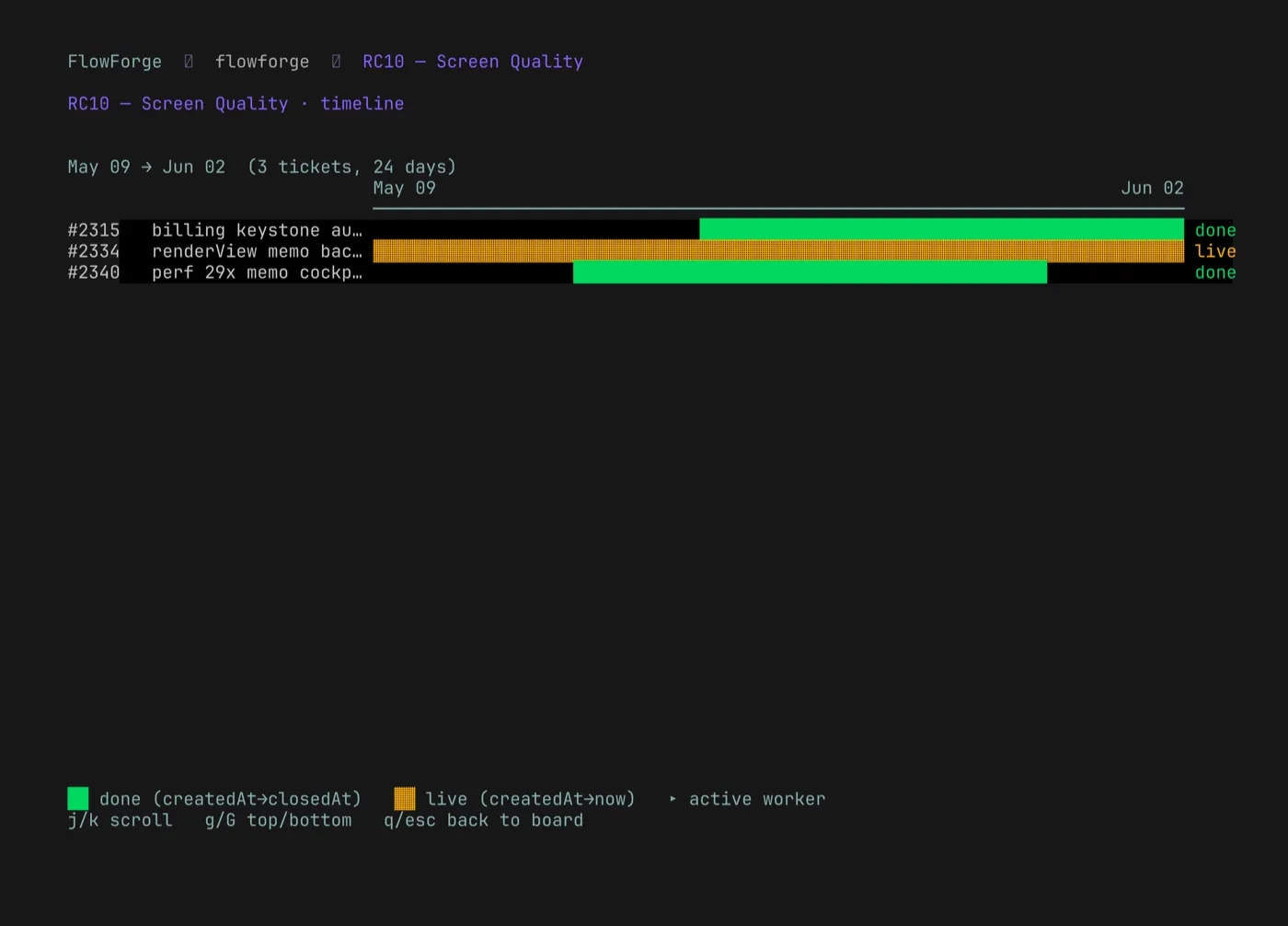
The stats surface turns your local, tracked history into a picture you can be proud of — the golden ticket that says, concretely, here is what I did and what it was worth.
Team billing
On a team, tracked time aggregates. Token usage and work are captured per developer through the canonical billing identity established at session start, so a team lead can see contribution honestly and each developer’s work rolls up without anyone having to reconstruct it after the fact. The same discipline that protects the individual — tracked, attributed, provable — protects the team’s ability to invoice accurately.
The vitrine, one more time
Recall the vitrine from the session discipline: your ticket is your shop window. Billing is where the shop window pays off. A month of disciplined sessions is not just a clean git history — it’s a defensible, queryable case:
- for an invoice, that the hours are real;
- for a raise or promotion, that the work was substantial and yours;
- for a retrospective, that the estimates and the reality can be compared honestly.
Work that left no trace can make none of these cases. Work tracked the FlowForge way makes all of them by default.
Why it matters
The craft is the point; the receipt is what keeps it fair. FlowForge exists so that fast, AI-assisted development stays honest, measurable, and yours — and the billing chapter is where the honest part becomes a record you can hand to anyone. You did the work, with a partner who never tired; FlowForge made sure you can prove it, bill it, and be paid for it. Never Alone, and never unpaid.